Pre-Summer Special Limited Time 70% Discount Offer - Ends in 0d 00h 00m 00s - Coupon code: validbest

Pass the Salesforce MuleSoft MuleSoft-Integration-Architect-I Questions and answers with ValidTests

Exam MuleSoft-Integration-Architect-I All Questions
Exam MuleSoft-Integration-Architect-I Premium Access

View all detail and faqs for the MuleSoft-Integration-Architect-I exam

Viewing page 3 out of 9 pages
Viewing questions 21-30 out of questions
Questions # 21:

A company is implementing a new Mule application that supports a set of critical functions driven by a rest API enabled, claims payment rules engine hosted on oracle ERP. As designed the mule application requires many data transformation operations as it performs its batch processing logic.

The company wants to leverage and reuse as many of its existing java-based capabilities (classes, objects, data model etc.) as possible

What approach should be considered when implementing required data mappings and transformations between Mule application and Oracle ERP in the new Mule application?

Options:

A.

Create a new metadata RAML classes in Mule from the appropriate Java objects and then perform transformations via Dataweave

B.

From the mule application, transform via theXSLT model

C.

Transform by calling any suitable Java class from Dataweave

D.

Invoke any of the appropriate Java methods directly, create metadata RAML classes and then perform required transformations via Dataweave

Expert Solution
Questions # 22:

An organization is evaluating using the CloudHub shared Load Balancer (SLB) vs creating a CloudHub dedicated load balancer (DLB). They are evaluating how this choice affects the various types of certificates used by CloudHub deplpoyed Mule applications, including MuleSoft-provided, customer-provided, or Mule application-provided certificates.

What type of restrictions exist on the types of certificates that can be exposed by the CloudHub Shared Load Balancer (SLB) to external web clients over the public internet?

Options:

A.

Only MuleSoft-provided certificates are exposed.

B.

Only customer-provided wildcard certificates are exposed.

C.

Only customer-provided self-signed certificates are exposed.

D.

Only underlying Mule application certificates are exposed (pass-through)

Expert Solution
Questions # 23:

A company is designing an integration Mule application to process orders by submitting them to a back-end system for offline processing. Each order will be received by the Mule application through an HTTP5 POST and must be acknowledged immediately.

Once acknowledged the order will be submitted to a back-end system. Orders that cannot be successfully submitted due to the rejections from the back-end system will need to be processed manually (outside the banking system).

The mule application will be deployed to a customer hosted runtime and will be able to use an existing ActiveMQ broker if needed. The ActiveMQ broker is located inside the organization's firewall. The back-end system has a track record of unreliability due to both minor network connectivity issues and longer outages.

Which combination of Mule application components and ActiveMQ queues are required to ensure automatic submission of orders to the back-end system while supporting but minimizing manual order processing?

Options:

A.

One or more On Error scopes to assist calling the back-end system An Untill successful scope containing VM components for long retries A persistent dead-letter VM queue configure in Cloud hub

B.

An Until Successful scope to call the back-end system One or more ActiveMQ long-retry queues One or more ActiveMQ dead-letter queues for manual processing

C.

One or more on-Error scopes to assist calling the back-end system one or more ActiveMQ long-retry queues A persistent dead-letter Object store configuration in the CloudHub object store service

D.

A batch job scope to call the back in system An Untill successful scope containing Object Store components for long retries. A dead-letter object store configured in the Mule application

Expert Solution
Questions # 24:

Which Anypoint Platform component helps integration developers discovers and share reusable APIs, connectors, and templates?

Options:

A.

Anypoint Exchange

B.

API Manager

C.

Anypoint Studio

D.

Design Center

Expert Solution
Questions # 25:

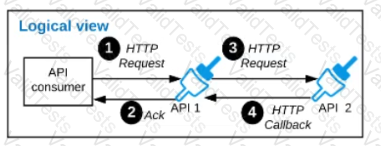
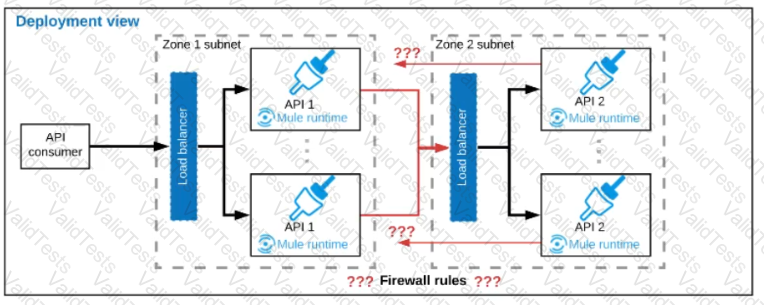
Refer to the exhibit.

Question # 25

Question # 25

A business process involves two APIs that interact with each other asynchronously over HTTP. Each API is implemented as a Mule application. API 1 receives the initial HTTP request and invokes API 2 (in a fire and forget fashion) while API 2, upon completion of the processing, calls back into API l to notify about completion of the asynchronous process.

Each API Is deployed to multiple redundant Mule runtimes and a separate load balancer, and is deployed to a separate network zone.

In the network architecture, how must the firewall rules be configured to enable the above Interaction between API 1 and API 2?

Options:

A.

To authorize the certificate to be used both APIs

B.

To enable communication from each API’s Mule Runtimes and Network zone to the load balancer of the other API

C.

To open direct two-way communication between the Mule Runtimes of both API’s

D.

To allow communication between load balancers used by each API

Expert Solution
Questions # 26:

An airline is architecting an API connectivity project to integrate its flight data into an online aggregation website. The interface must allow for secure communication high-performance and asynchronous message exchange.

What are suitable interface technologies for this integration assuming that Mulesoft fully supports these technologies and that Anypoint connectors exist for these interfaces?

Options:

A.

AsyncAPI over HTTPS

AMQP with RabbitMQ JSON/REST over HTTPS

B.

XML over ActiveMQ XML over SFTP XML/REST over HTTPS

C.

CSV over FTP YAM L over TLS JSON over HTTPS

D.

SOAP over HTTPS HOP over TLS gRPC over HTTPS

Expert Solution
Questions # 27:

A Mule application contains a Batch Job scope with several Batch Step scopes. The Batch Job scope is configured with a batch block size of 25.

A payload with 4,000 records is received by the Batch Job scope.

When there are no errors, how does the Batch Job scope process records within and between the Batch Step scopes?

Options:

A.

The Batch Job scope processes multiple record blocks in parallel, and a block of 25 records can jump ahead to the next Batch Step scope over an earlier block of records

Each Batch Step scope is invoked with one record in the payload of the received Mule event

For each Batch Step scope, all 25 records within a block are processed in parallel

All the records in a block must be completed before the block of 25 records is avai

B.

The Batch Job scope processes each record block sequentially, one at a time

Each Batch Step scope is invoked with one record in the payload of the received Mule event

For each Batch Step scope, all 25 records within a block are processed sequentially, one at a time

All 4000 records must be completed before the blocks of records are available to the next Batch Step scope

C.

The Batch Job scope processes multiple record blocks in parallel, and a block of 25 records can jump ahead to the next Batch Step scope over an earlier block of records

Each Batch Step scope is invoked with one record in the payload of the received Mule event

For each Batch Step scope, all 25 records within a block are processed sequentially, one record at a time

All the records in a block must be completed before the bloc

D.

The Batch Job scope processes multiple record blocks in parallel

Each Batch Step scope is invoked with a batch of 25 records in the payload of the received Mule event

For each Batch Step scope, all 4000 records are processed in parallel

Individual records can jump ahead to the next Batch Step scope before the rest of the records finish processing in the current Batch Step scope

Expert Solution
Questions # 28:

An organization currently uses a multi-node Mule runtime deployment model within their datacenter, so each Mule runtime hosts several Mule applications. The organization is planning to transition to a deployment model based on Docker containers in a Kubernetes cluster. The organization has already created a standard Docker image containing a Mule runtime and all required dependencies (including a JVM), but excluding the Mule application itself.

What is an expected outcome of this transition to container-based Mule application deployments?

Options:

A.

Required redesign of Mule applications to follow microservice architecture principles

B.

Required migration to the Docker and Kubernetes-based Anypoint Platform - Private Cloud Edition

C.

Required change to the URL endpoints used by clients to send requests to the Mule applications

D.

Guaranteed consistency of execution environments across all deployments of a Mule application

Expert Solution
Questions # 29:

In one of the critical payment related mule application, transaction is being used . As an enhancement to implementation , scatter gather route is introduced which is also the part of transaction group. Scatter gather route has 4 routes.

What will be the behavior of the Mule application in case of error occurs in 4th route of the scatter-gather router and transaction needs to be rolled back?

Options:

A.

Only errored route will be rolled back

B.

All routes will be rolled back

C.

Scatter Gather router cannot be part of transaction

Expert Solution
Questions # 30:

An organization will deploy Mule applications to Cloudhub, Business requirements mandate that all application logs be stored ONLY in an external splunk consolidated logging service and NOT in Cloudhub.

In order to most easily store Mule application logs ONLY in Splunk, how must Mule application logging be configured in Runtime Manager, and where should the log4j2 splunk appender be defined?

Options:

A.

Keep the default logging configuration in RuntimeManager

Define the splunk appender in ONE global log4j.xml file that is uploaded once to Runtime Manager to support at Mule application deployments.

B.

Disable Cloudhub logging in Runtime Manager

Define the splunk appender in EACH Mule application’s log4j2.xml file

C.

Disable Cloudhub logging in Runtime Manager

Define the splunk appender in ONE global log4j.xml file that is uploaded once to Runtime Manger to support at Mule application deployments.

D.

Keep the default logging configuration in Runtime Manager

Define the Splunk appender in EACH Mule application log4j2.xml file

Expert Solution
Viewing page 3 out of 9 pages
Viewing questions 21-30 out of questions