Pre-Summer Special Limited Time 70% Discount Offer - Ends in 0d 00h 00m 00s - Coupon code: validbest

Pass the Salesforce MuleSoft MuleSoft-Integration-Architect-I Questions and answers with ValidTests

Exam MuleSoft-Integration-Architect-I All Questions
Exam MuleSoft-Integration-Architect-I Premium Access

View all detail and faqs for the MuleSoft-Integration-Architect-I exam

Viewing page 6 out of 9 pages
Viewing questions 51-60 out of questions
Questions # 51:

An IT integration delivery team begins a project by gathering all of the requirements, and proceeds to execute the remaining project activities as sequential, non-repeating phases.

Which IT project delivery methodology is this team following?

Options:

A.

Kanban

B.

Scrum

C.

Waterfall

D.

Agile

Expert Solution
Questions # 52:

An organization is choosing between API-led connectivity and other integration approaches.

According to MuleSoft, which business benefits is associated with an API-led connectivity approach using Anypoint Platform?

Options:

A.

improved security through adoption of monolithic architectures

B.

Increased developer productivity through sell-service of API assets

C.

Greater project predictability through tight coupling of systems

D.

Higher outcome repeatability through centralized development

Expert Solution
Questions # 53:

A MuteSoft developer must implement an API as a Mule application, run the application locally, and execute unit tests against the Running application.

Which Anypoint Platform component can the developer use to full all of these requirements?

Options:

A.

API Manager

B.

API Designer

C.

Anypoint CLI

D.

Anypoint Studio

Expert Solution
Questions # 54:

A company is using Mulesoft to develop API's and deploy them to Cloudhub and on premises targets. Recently it has decided to enable Runtime Fabric deployment option as well and infrastructure is set up for this option.

What can be used to deploy Runtime Fabric?

Options:

A.

AnypointCLI

B.

Anypoint platform REST API's

C.

Directly uploading ajar file from the Runtime manager

D.

Mule maven plug-in

Expert Solution
Questions # 55:

A leading e-commerce giant will use Mulesoft API's on runtime fabric (RTF) to process customer orders. Some customer's sensitive information such as credit card information is also there as a part of a API payload.

What approach minimizes the risk of matching sensitive data to the original and can convert back to the original value whenever and wherever required?

Options:

A.

Apply masking to hide the sensitive information and then use API

B.

manager to detokenize the masking format to return the original value

C.

create a tokenization format and apply a tokenization policy to the API Gateway

D.

Used both masking and tokenization

E.

Apply a field level encryption policy in the API Gateway

Expert Solution
Questions # 56:

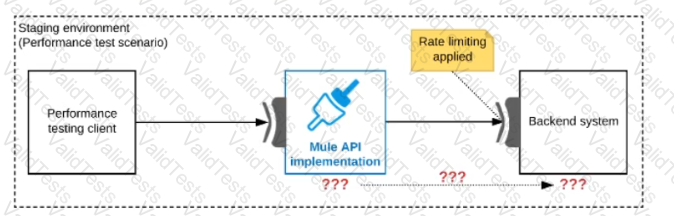
Refer to the exhibit.

Question # 56

One of the backend systems invoked by an API implementation enforces rate limits on the number of requests a particular client can make. Both the backend system and the API implementation are deployed to several non-production environments in addition to production.

Rate limiting of the backend system applies to all non-production environments. The production environment, however, does NOT have any rate limiting.

What is the most effective approach to conduct performance tests of the API implementation in a staging (non-production) environment?

Options:

A.

Create a mocking service that replicates the backend system's production performance characteristics. Then configure the API implementation to use the mocking service and conduct the performance tests

B.

Use MUnit to simulate standard responses from the backend system then conduct performance tests to identify other bottlenecks in the system

C.

Include logic within the API implementation that bypasses invocations of the backend system in a performance test situation. Instead invoking local stubs that replicate typical backend system responses then conduct performance tests using this API Implementation

D.

Conduct scaled-down performance tests in the staging environment against the rate limited backend system then upscale performance results to full production scale

Expert Solution
Questions # 57:

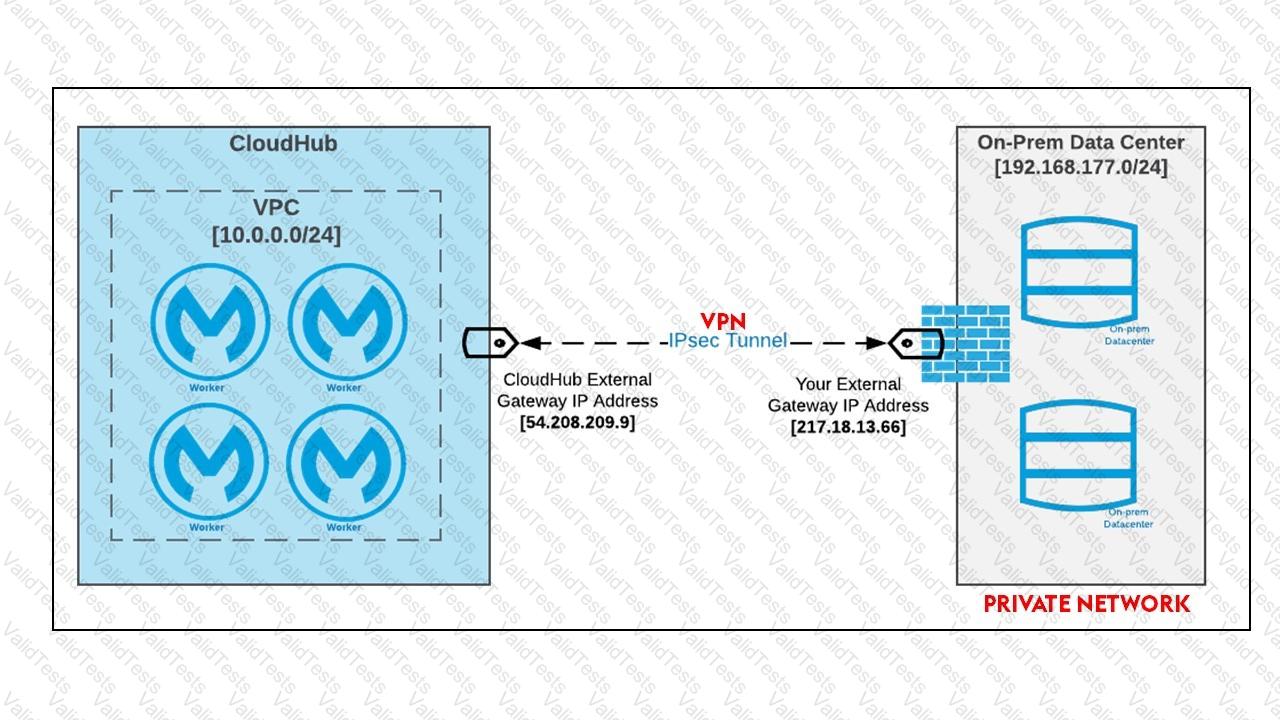
Mule applications need to be deployed to CloudHub so they can access on-premises database systems. These systems store sensitive and hence tightly protected data, so are not accessible over the internet.

What network architecture supports this requirement?

Options:

A.

An Anypoint VPC connected to the on-premises network using an IPsec tunnel or AWS DirectConnect, plus matching firewall rules in the VPC and on-premises network

B.

Static IP addresses for the Mule applications deployed to the CloudHub Shared Worker Cloud, plus matching firewall rules and IP

whitelisting in the on-premises network

C.

An Anypoint VPC with one Dedicated Load Balancer fronting each on-premises database system, plus matching IP whitelisting in the load balancer and firewall rules in the VPC and on-premises network

D.

Relocation of the database systems to a DMZ in the on-premises network, with Mule applications deployed to the CloudHub Shared Worker Cloud connecting only to the DMZ

Expert Solution
Questions # 58:

A new Mule application under development must implement extensive data transformation logic. Some of the data transformation functionality is already available as external transformation services that are mature and widely used across the organization; the rest is highly specific to the new Mule application.

The organization follows a rigorous testing approach, where every service and application must be extensively acceptance tested before it is allowed to go into production.

What is the best way to implement the data transformation logic for this new Mule application while minimizing the overall testing effort?

Options:

A.

Implement and expose all transformation logic as mlaoservices using DataWeave, so it can be reused by any application component that needs it, including the new Mule application

B.

Implement transformation logic in the new Mute application using DataWeave, replicating the transformation logic of existing transformation services

C.

Extend the existing transformation services with new transformation logic and Invoke them from the new Mule application

D.

Implement transformation logic in the new Mute application using DataWeave, invoking existing transformation services when possible

Expert Solution
Questions # 59:

The AnyAirline organization's passenger reservations center is designing an integration solution that combines invocations of three different System APIs (bookFlight, bookHotel, and bookCar) in a business transaction. Each System API makes calls to a single database.

The entire business transaction must be rolled back when at least one of the APIs fails.

What is the most idiomatic (used for its intended purpose) way to integrate these APIs in near real-time that provides the best balance of consistency, performance, and reliability?

Options:

A.

Implement eXtended Architecture (XA) transactions between the API implementations

Coordinate between the API implementations using a Saga pattern

Implement caching in each API implementation to improve performance

B.

Implement local transactions within each API implementation

Configure each API implementation to also participate in the same eXtended Architecture (XA) transaction

Implement caching in each API implementation to improve performance

C.

Implement local transactions in each API implementation

Coordinate between the API implementations using a Saga pattern

Apply various compensating actions depending on where a failure occurs

D.

Implement an eXtended Architecture (XA) transaction manager in a Mule application using a Saga pattern

Connect each API implementation with the Mule application using XA transactions

Apply various compensating actions depending on where a failure occurs

Expert Solution
Questions # 60:

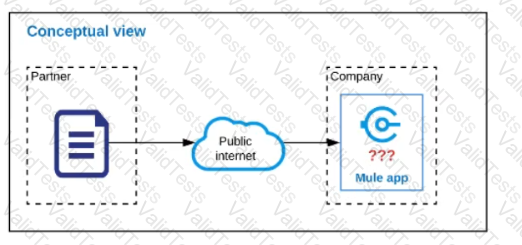
Refer to the exhibit.

An organization is designing a Mule application to receive data from one external business partner. The two companies currently have no shared IT infrastructure and do not want to establish one. Instead, all communication should be over the public internet (with no VPN).

What Anypoint Connector can be used in the organization's Mule application to securely receive data from this external business partner?

Question # 60

Options:

A.

File connector

B.

VM connector

C.

SFTP connector

D.

Object Store connector

Expert Solution
Viewing page 6 out of 9 pages
Viewing questions 51-60 out of questions