Pre-Summer Special Limited Time 70% Discount Offer - Ends in 0d 00h 00m 00s - Coupon code: validbest

Pass the Salesforce MuleSoft MuleSoft-Integration-Architect-I Questions and answers with ValidTests

Exam MuleSoft-Integration-Architect-I All Questions
Exam MuleSoft-Integration-Architect-I Premium Access

View all detail and faqs for the MuleSoft-Integration-Architect-I exam

Viewing page 8 out of 9 pages
Viewing questions 71-80 out of questions
Questions # 71:

What approach configures an API gateway to hide sensitive data exchanged between API consumers and API implementations, but can convert tokenized fields back to their original value for other API requests or responses, without having to recode the API implementations?

Options:

A.

Create both masking and tokenization formats and use both to apply a tokenization policy in an API gateway to mask sensitive values in message payloads withcharacters, and apply a corresponding detokenization policy to return the original

values to other APIs

B.

Create a masking format and use it to apply a tokenization policy in an API gateway to mask sensitive values in message payloads with characters, and apply a corresponding detokenization policy to return the original values to other APIs

C.

Use a field-level encryption policy in an API gateway to replace sensitive fields in message payload with encrypted values, and apply a corresponding field-level

decryption policy to return the original values to other APIs

D.

Create a tokenization format and use it to apply a tokenization policy in an API gateway to replace sensitive fields in message payload with similarly formatted

tokenized values, and apply a corresponding detokenization policy to return the original values to other APIs

Expert Solution
Questions # 72:

What operation can be performed through a JMX agent enabled in a Mule application?

Options:

A.

View object store entries

B.

Replay an unsuccessful message

C.

Set a particular tog4J2 log level to TRACE

D.

Deploy a Mule application

Expert Solution
Questions # 73:

A large life sciences customer plans to use the Mule Tracing module with the Mapped Diagnostic Context (MDC) logging operations to enrich logging in its Mule application and to improve tracking by providing more context in the Mule application logs. The customer also wants to improve throughput and lower the message processing latency in its Mule application flows.

After installing the Mule Tracing module in the Mule application, how should logging be performed in flows in Mule applications, and what should be changed In the log4j2.xml files?

Options:

A.

In the flows, add Mule Tracing module Set logging variable operations before any Core Logger components.

In log4j2.xml files, change the appender's pattern layout to use %MDC and then assign the appender to a Logger or Root element.

B.

In the flows, add Mule Tracing module Set logging variable operations before any Core

Logger components.

In log4j2.xmI files, change the appender’s pattern layout to use the %MDC placeholder and then assign the appender to an AsyncLogger element.

C.

In the flows, add Mule Tracing module Set logging variable operations before any Core

Logger components.

In log4j2.xmI files, change the appender’'s pattern layout to use %asyncLogger placeholder and then assign the appender to an AsyncLogger element.

D.

In the flows, wrap Logger components in Async scopes. In log4j2.xmI files, change the appender's pattern layout to use the %asyncLogger

placeholder and then assign the appender to a Logger or Root element.

Expert Solution
Questions # 74:

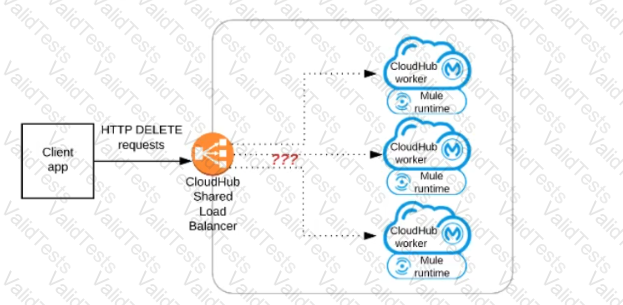
Refer to the exhibit.

Question # 74

A Mule application has an HTTP Listener that accepts HTTP DELETE requests. This Mule application Is deployed to three CloudHub workers under the control of the CloudHub Shared Load Balancer.

A web client makes a sequence of requests to the Mule application's public URL.

How is this sequence of web client requests distributed among the HTTP Listeners running in the three CloudHub workers?

Options:

A.

Each request is routed to the PRIMARY CloudHub worker in the PRIMARY Availability Zone (AZ)

B.

Each request is routed to ONE ARBiTRARY CloudHub worker in the PRIMARY Availability Zone (AZ)

C.

Each request Is routed to ONE ARBiTRARY CloudHub worker out of ALL three CloudHub workers

D.

Each request is routed (scattered) to ALL three CloudHub workers at the same time

Expert Solution
Questions # 75:

An organization is using Mulesoft cloudhub and develops API's in the latest version. As a part of requirements for one of the API's, third party API needs to be called. The security team has made it clear that calling any external API needs to have include listing

As an integration architect please suggest the best way to accomplish the design plan to support these requirements?

Options:

A.

Implement includelist IP on the cloudhub VPC firewall to allow the traffic

B.

Implement the validation of includelisted IP operation

C.

Implement the Any point filter processor to implement the include list IP

D.

Implement a proxy for the third party API and enforce the IPinclude list policy and call this proxy from the flow of the API

Expert Solution
Questions # 76:

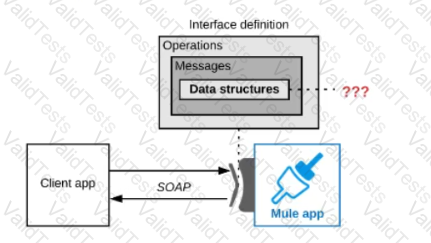
Refer to the exhibit.

A Mule application is being designed to expose a SOAP web service to its clients.

What language is typically used inside the web service's interface definition to define the data structures that the web service Is expected to exchange with its clients?
Question # 76

Options:

A.

WSDL

B.

XSD

C.

JSON Schema

D.

RAMI

Expert Solution
Questions # 77:

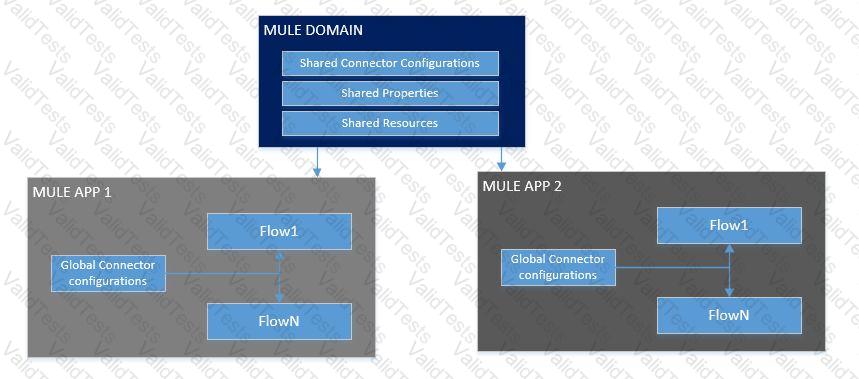
What is not true about Mule Domain Project?

Options:

A.

This allows Mule applications to share resources

B.

Expose multiple services within the Mule domain on the same port

C.

Only available Anypoint Runtime Fabric

D.

Send events (messages) to other Mule applications using VM queues

Expert Solution
Questions # 78:

An external API frequently invokes an Employees System API to fetch employee data from a MySQL database. The architect must design a caching strategy to query the database only when there Is an update to the Employees table or else return a cached response in order to minimize the number of redundant transactions being handled by the database.

Options:

A.

Use an On Table Row operation configured with the Employees table, call invalidate cache, and hardcode the new Employees data to cache. Use an object-store-caching-strategy and set the expiration interval to 1 hour.

B.

Use an On Table Row operation configured with the Employees table and cail invalidate cache. Use an object-store-caching-strategy and the default expiration interval.

C.

Use a Scheduler with a fixed frequency set to every hour to trigger an invalidate cache flow. Use an object-store-caching-strategy and the default expiration interval.

D.

Use a Scheduler with a fixed frequency set to every hour, triggering an invalidate cache flow. Use an object-store-caching-strategy and set the expiration interval to 1 hour.

Expert Solution
Questions # 79:

What Mule application can have API policies applied by Anypoint Platform to the endpoint exposed by that Mule application?

Options:

A.

A Mule application that accepts requests over HTTP/1x

B.

A Mule application that accepts JSON requests over TCP but is NOT required to provide a response.

C.

A Mule application that accepts JSON requests over WebSocket

D.

A Mule application that accepts gRPC requests over HTTP/2

Expert Solution
Questions # 80:

In Anypoint Platform, a company wants to configure multiple identity providers (IdPs) for multiple lines of business (LOBs). Multiple business groups, teams, and environments have been defined for these LOBs.

What Anypoint Platform feature can use multiple IdPs across the company’s business groups, teams, and environments?

Options:

A.

MuleSoft-hosted (CloudHub) dedicated load balancers

B.

Client (application) management

C.

Virtual private clouds

D.

Permissions

Expert Solution
Viewing page 8 out of 9 pages
Viewing questions 71-80 out of questions