Pre-Summer Special Limited Time 70% Discount Offer - Ends in 0d 00h 00m 00s - Coupon code: validbest

Pass the Salesforce MuleSoft MuleSoft-Integration-Architect-I Questions and answers with ValidTests

Exam MuleSoft-Integration-Architect-I All Questions
Exam MuleSoft-Integration-Architect-I Premium Access

View all detail and faqs for the MuleSoft-Integration-Architect-I exam

Viewing page 7 out of 9 pages
Viewing questions 61-70 out of questions
Questions # 61:

A company is modernizing its legal systems lo accelerate access lo applications and data while supporting the adoption of new technologies. The key to achieving this business goal is unlocking the companies' key systems and dala including microservices miming under Docker and kubernetes containers using apis.

Considering the current aggressive backlog and project delivery requirements the company wants to take a strategic approach in the first phase of its transformation projects by quickly deploying API's in mule runtime that are able lo scale, connect to on premises systems and migrate as needed.

Which runtime deployment option supports company's goals?

Options:

A.

Customer hosted self provisioned runtimes

B.

Cloudhub runtimes

C.

Runtime fabric on self managed Kubernetes

D.

Runtime fabric on Vmware metal

Expert Solution
Questions # 62:

According to the Internet Engineering Task Force (IETF), which supporting protocol does File Transfer Protocol (FTP) use for reliable communication?

Options:

A.

A Secure Sockets Layer (SSL)

B.

B Transmission Control Protocol (TCP)

C.

Lightweight Directory Access Protocol (LDAP)

D.

Hypertext Transfer Protocol (HTTP)

Expert Solution
Questions # 63:

An organization has decided on a cloudhub migration strategy that aims to minimize the organizations own IT resources. Currently, the organizational has all of its Mule applications running on its own premises and uses an premises load balancer that exposes all APIs under the base URL https://api.acme.com

As part of the migration strategy, the organization plans to migrate all of its Mule applications and load balancer to cloudhub

What is the most straight-forward and cost effective approach to the Mule applications deployment and load balancing that preserves the public URLs?

Options:

A.

Deploy the Mule applications to Cloudhub

Update the CNAME record for an api.acme.com in the organizations DNS server pointing to the A record of a cloudhub dedicated load balancer(DLB)

Apply mapping rules in the DLB to map URLs to their corresponding Mule applications

B.

For each migrated Mule application, deploy an API proxy Mule application to Cloudhub with all applications under the control of a dedicated load balancer(CLB)

Update the CNAME record for api.acme.com in the organization DNS server pointing to the A record of a cloudhub dedicated load balancer(DLB)

Apply mapping rules in the DLB to map each API proxy application to its corresponding Mule applications

C.

Deploy the Mule applications to Cloudhub

Create CNAME record for api.acme.com in the Cloudhub Shared load balancer (SLB) pointing to the A record of the on-premise load balancer

Apply mapping rules in the SLB to map URLs to their corresponding Mule applications

D.

Deploy the Mule applications to Cloudhub

Update the CNAME record for api.acme.com in the organization DNS server pointing to the A record of the cloudhub shared load balancer(SLB)

Apply mapping rules in the SLB to map URLs to their corresponding Mule applications.

Expert Solution
Questions # 64:

Customer has deployed mule applications to different customer hosted mule run times. Mule applications are managed from Anypoint platform.

What needs to be configured to monitor these Mule applications from Anypoint monitoring and what sends monitoring data to Anypoint monitoring?

Options:

A.

Enable monitoring of individual applications from runtime manager application settings

Runtime manager agent sends monitoring data from the mule applications to Anypoint monitoring

B.

Install runtime manager agent on each mule runtime

Runtime manager agent since monitoring data from the mule applications to Anypoint monitoring

C.

Anypoint monitoring agent on each mule runtime

Anypoint monitoring agent sends monitoring data from the mule applications to Anypoint monitoring

D.

By default, Anypoint monitoring agent will be installed on each Mule run time

Anypoint Monitoring agent automatically sends monitoring data from the Mule applications to Anypoint monitoring

Expert Solution
Questions # 65:

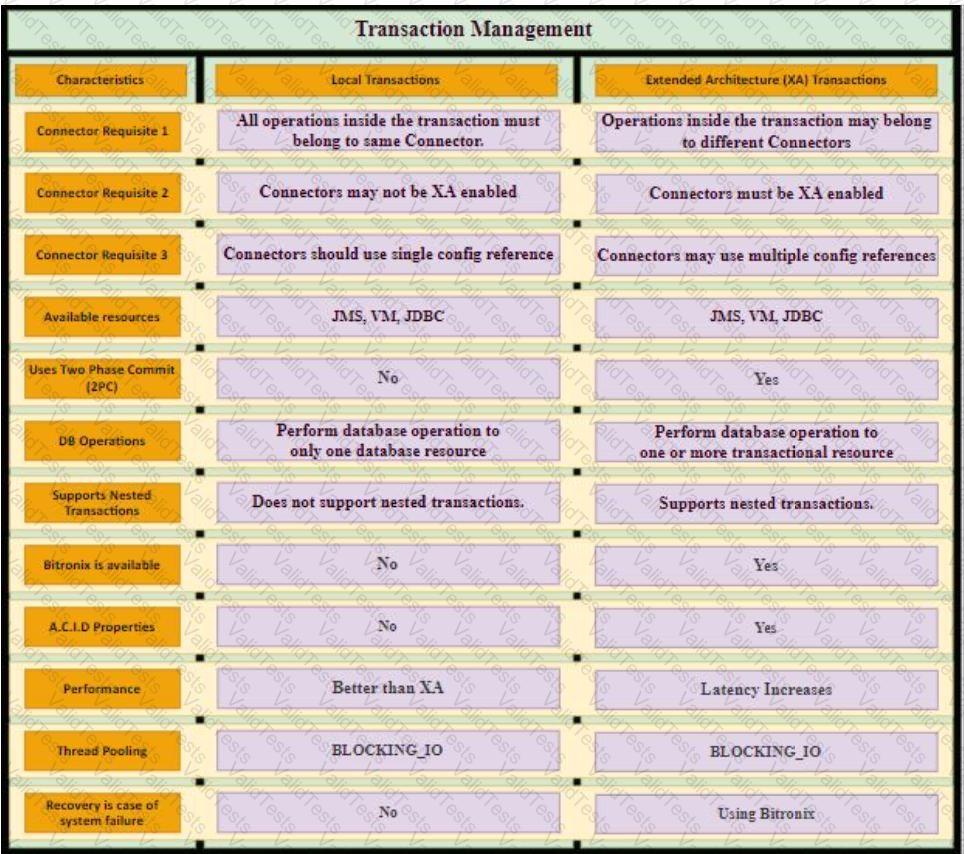
An XA transaction Is being configured that involves a JMS connector listening for Incoming JMS messages. What is the meaning of the timeout attribute of the XA transaction, and what happens after the timeout expires?

Options:

A.

The time that is allowed to pass between committing the transaction and the completion of the Mule flow After the timeout, flow processing triggers an error

B.

The time that Is allowed to pass between receiving JMS messages on the same JMS connection After the timeout, a new JMS connection Is established

C.

The time that Is allowed to pass without the transaction being ended explicitly After the timeout, the transaction Is forcefully rolled-back

D.

The time that Is allowed to pass for state JMS consumer threads to be destroyed After the timeout, a new JMS consumer thread is created

Expert Solution
Questions # 66:

A team has completed the build and test activities for a Mule application that implements a System API for its application network.

Which Anypoint Platform component should the team now use to both deploy and monitor the System AP\ implementation?

Options:

A.

API Manager

B.

Design Center

C.

Anypoint Exchange

D.

Runtime Manager

Expert Solution
Questions # 67:

A mule application designed to fulfil two requirements

a) Processing files are synchronously from an FTPS server to a back-end database using VM intermediary queues for load balancing VM events

b) Processing a medium rate of records from a source to a target system using batch job scope

Considering the processing reliability requirements for FTPS files, how should VM queues be configured for processing files as well as for the batch job scope if the application is deployed to Cloudhub workers?

Options:

A.

Use Cloud hub persistent queues for FTPS files processing

There is no need to configure VM queues for the batch jobs scope as it uses by default the worker's disc for VM queueing

B.

Use Cloud hub persistent VM queue for FTPS file processing

There is no need to configure VM queues for the batch jobs scope as it uses by default the worker's JVM memory for VM queueing

C.

Use Cloud hub persistent VM queues for FTPS file processing

Disable VM queue for the batch job scope

D.

Use VM connector persistent queues for FTPS file processing Disable VM queue for the batch job scope

Expert Solution
Questions # 68:

How does timeout attribute help inform design decisions while using JMS connector listening for incoming messages in an extended architecture (XA) transaction?

Options:

A.

After the timeout is exceeded, stale JMS consumer threads are destroyed and new threads are created

B.

The timeout specifies the time allowed to pass between receiving JMS messages on the same JMS connection and then after the timeout new JMS connection is established

C.

The time allowed to pass between committing the transaction and the completion of the mule flow and then after the timeout flow processing triggers an error

D.

The timeout defines the time that is allowed to pass without the transaction ending explicitly and after the timeout expires, the transaction rolls back

Expert Solution
Questions # 69:

An organization is successfully using API led connectivity, however, as the application network grows, all the manually performed tasks to publish share and discover, register, apply policies to, and deploy an API are becoming repetitive pictures driving the organization to automate this process using efficient CI/'CD pipeline. Considering Anypoint platforms capabilities how should the organization approach automating is API lifecycle?

Options:

A.

Use runtime manager rest apis for API management and mavenforAPI deployment

B.

Use Maven with a custom configuration required for the API lifecycle

C.

Use Anypoint CLI or Anypoint Platform REST apis with scripting language such as groovy

D.

Use Exchange rest api's for API management and MavenforAPI deployment

Expert Solution
Questions # 70:

What aspects of a CI/CD pipeline for Mute applications can be automated using MuleSoft-provided Maven plugins?

Options:

A.

Compile, package, unit test, deploy, create associated API instances in API Manager

B Import from API designer, compile, package, unit test, deploy, publish to Am/point Exchange

B.

Compile, package, unit test, validate unit test coverage, deploy

C.

Compile, package, unit test, deploy, integration test

Expert Solution
Viewing page 7 out of 9 pages
Viewing questions 61-70 out of questions