Pre-Summer Special Limited Time 70% Discount Offer - Ends in 0d 00h 00m 00s - Coupon code: validbest

Pass the Salesforce MuleSoft MuleSoft-Integration-Architect-I Questions and answers with ValidTests

Exam MuleSoft-Integration-Architect-I All Questions
Exam MuleSoft-Integration-Architect-I Premium Access

View all detail and faqs for the MuleSoft-Integration-Architect-I exam

Viewing page 9 out of 9 pages
Viewing questions 81-90 out of questions
Questions # 81:

An integration Mule application is deployed to a customer-hosted multi-node Mule 4 runtime duster. The Mule application uses a Listener operation of a JMS connector to receive incoming messages from a JMS queue.

How are the messages consumed by the Mule application?

Options:

A.

Depending on the JMS provider's configuration, either all messages are consumed by ONLY the primary cluster node or else ALL messages are consumed by ALL cluster nodes

B.

Regardless of the Listener operation configuration, all messages are consumed by ALL cluster nodes

C.

Depending on the Listener operation configuration, either all messages are consumed by ONLY the primary cluster node or else EACH message is consumed by ANY ONE cluster node

D.

Regardless of the Listener operation configuration, all messages are consumed by ONLY the primary cluster node

Expert Solution
Questions # 82:

Refer to the exhibit.

A Mule 4 application has a parent flow that breaks up a JSON array payload into 200 separate items, then sends each item one at a time inside an Async scope to a VM queue.

A second flow to process orders has a VM Listener on the same VM queue. The rest of this flow processes each received item by writing the item to a database.

This Mule application is deployed to four CloudHub workers with persistent queues enabled.

What message processing guarantees are provided by the VM queue and the CloudHub workers, and how are VM messages routed among the CloudHub workers for each invocation of the parent flow under normal operating conditions where all the CloudHub workers remain online?

Options:

A.

EACH item VM message is processed AT MOST ONCE by ONE CloudHub worker, with workers chosen in a deterministic round-robin fashion Each of the four CloudHub workers can be expected to process 1/4 of the Item VM messages (about 50 items)

B.

EACH item VM message is processed AT LEAST ONCE by ONE ARBITRARY CloudHub worker Each of the four CloudHub workers can be expected to process some item VM messages

C.

ALL Item VM messages are processed AT LEAST ONCE by the SAME CloudHub worker where the parent flow was invokedThis one CloudHub worker processes ALL 200 item VM messages

D.

ALL item VM messages are processed AT MOST ONCE by ONE ARBITRARY CloudHub workerThis one CloudHub worker processes ALL 200 item VM messages

Questions # 83:

A new upstream API Is being designed to offer an SLA of 500 ms median and 800 ms maximum (99th percentile) response time. The corresponding API implementation needs to sequentially invoke 3 downstream APIs of very similar complexity. The first of these downstream APIs offers the following SLA for its response time: median: 100 ms, 80th percentile: 500 ms, 95th percentile: 1000 ms. If possible, how can a timeout be set in the upstream API for the invocation of the first downstream API to meet the new upstream API's desired SLA?

Options:

A.

Set a timeout of 100 ms; that leaves 400 ms for the other two downstream APIs to complete

B.

Do not set a timeout; the Invocation of this API Is mandatory and so we must wait until it responds

C.

Set a timeout of 50 ms; this times out more invocations of that API but gives additional room for retries

D.

No timeout is possible to meet the upstream API's desired SLA; a different SLA must be negotiated with the first downstream API or invoke an alternative API

Questions # 84:

What requirement prevents using Anypoint MQ as the messaging broker for a Mule application?

Options:

A.

When the payload sent through the message broker must use XML format

B.

When the payload sent through the message broker must be encrypted

C.

When the messaging broker must support point-to-point messaging

D.

When the messaging broker must be deployed on-premises

Questions # 85:

What Is a recommended practice when designing an integration Mule 4 application that reads a large XML payload as a stream?

Options:

A.

The payload should be dealt with as a repeatable XML stream, which must only be traversed (iterated-over) once and CANNOT be accessed randomly from DataWeave expressions and scripts

B.

The payload should be dealt with as an XML stream, without converting it to a single Java object (POJO)

C.

The payload size should NOT exceed the maximum available heap memory of the Mute runtime on which the Mule application executes

D.

The payload must be cached using a Cache scope If It Is to be sent to multiple backend systems

Questions # 86:

A Mule application currently writes to two separate SQL Server database instances across the internet using a single XA transaction. It is 58. proposed to split this one transaction into two separate non-XA transactions with no other changes to the Mule application.

What non-functional requirement can be expected to be negatively affected when implementing this change?

Options:

A.

Throughput

B.

Consistency

C.

Response time

D.

Availability

Questions # 87:

An organization designing a hybrid, load balanced, single cluster production environment. Due to performance service level agreement goals, it is looking into running the Mule applications in an active-active multi node cluster configuration.

What should be considered when running its Mule applications in this type of environment?

Options:

A.

All event sources, regardless of time , can be configured as the target source by the primary node in the cluster

B.

An external load balancer is required to distribute incoming requests throughout the cluster nodes

C.

A Mule application deployed to multiple nodes runs in an isolation from the other nodes in the cluster

D.

Although the cluster environment is fully installed configured and running, it will not process any requests until an outage condition is detected by the primary node in the cluster.

Questions # 88:

An auto mobile company want to share inventory updates with dealers Dl and D2 asynchronously and concurrently via queues Q1 and Q2. Dealer Dl must consume the message from the queue Q1 and dealer D2 to must consume a message from the queue Q2.

Dealer D1 has implemented a retry mechanism to reprocess the transaction in case of any errors while processing the inventers updates. Dealer D2 has not implemented any retry mechanism.

How should the dealers acknowledge the message to avoid message loss and minimize impact on the current implementation?

Options:

A.

Dealer D1 must use auto acknowledgement and dealer D2 can use manual acknowledgement and acknowledge the message after successful processing

B.

Dealer D1 can use auto acknowledgement and dealer D2 can use IMMEDIATE acknowledgement and acknowledge the message of successful processing

C.

Dealer D1 and dealer D2 must use AUTO acknowledgement and acknowledge the message after successful processing

D.

Dealer D1 can use AUTO acknowledgement and dealer D2 must use manual acknowledgement and acknowledge the message after successful processing

Questions # 89:

Refer to the exhibit.

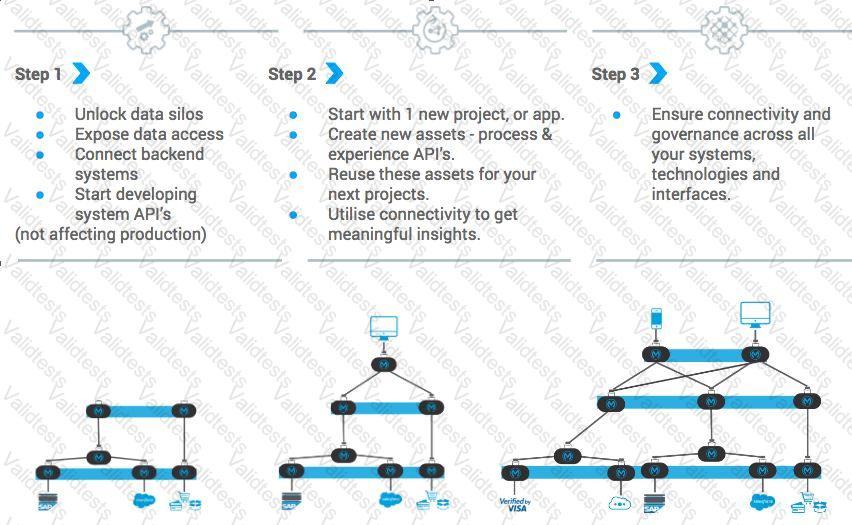
A business process involves the receipt of a file from an external vendor over SFTP. The file needs to be parsed and its content processed, validated, and ultimately persisted to a database. The delivery mechanism is expected to change in the future as more vendors send similar files using other mechanisms such as file transfer or HTTP POST.

What is the most effective way to design for these requirements in order to minimize the impact of future change?

Options:

A.

Use a MuleSoft Scatter-Gather and a MuleSoft Batch Job to handle the different files coming from different sources

B.

Create a Process API to receive the file and process it using a MuleSoft Batch Job while delegating the data save process to a System API

C.

Create an API that receives the file and invokes a Process API with the data contained In the file, then have the Process API process the data using a MuleSoft Batch Job and other System APIs as needed

D.

Use a composite data source so files can be retrieved from various sources and delivered to a MuleSoft Batch Job for processing

Questions # 90:

A Mule application is synchronizing customer data between two different database systems.

What is the main benefit of using XA transaction over local transactions to synchronize these two database system?

Options:

A.

Reduce latency

B.

Increase throughput

C.

Simplifies communincation

D.

Ensure consistency

Viewing page 9 out of 9 pages
Viewing questions 81-90 out of questions