View all detail and faqs for the MuleSoft-Integration-Architect-I exam
A banking company is developing a new set of APIs for its online business. One of the critical API's is a master lookup API which is a system API. This master lookup API uses persistent object store. This API will be used by all other APIs to provide master lookup data.
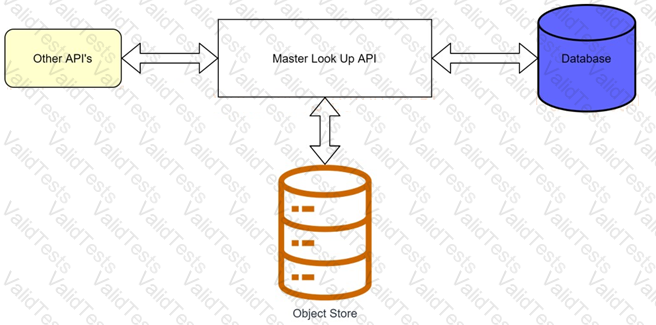
Master lookup API is deployed on two cloudhub workers of 0.1 vCore each because there is a lot of master data to be cached. Master lookup data is stored as a key value pair. The cache gets refreshed if they key is not found in the cache.
Doing performance testing it was observed that the Master lookup API has a higher response time due to database queries execution to fetch the master lookup data.
Due to this performance issue, go-live of the online business is on hold which could cause potential financial loss to Bank.
As an integration architect, which of the below option you would suggest to resolve performance issue?
An organization uses one specific CloudHub (AWS) region for all CloudHub deployments. How are CloudHub workers assigned to availability zones (AZs) when the organization's Mule applications are deployed to CloudHub in that region?
Additional nodes are being added to an existing customer-hosted Mule runtime cluster to improve performance. Mule applications deployed to this cluster are invoked by API clients through a load balancer.
What is also required to carry out this change?
What is true about automating interactions with Anypoint Platform using tools such as Anypoint Platform REST API's, Anypoint CLI or the Mule Maven plugin?
A mule application is deployed to a Single Cloudhub worker and the public URL appears in Runtime Manager as the APP URL.
Requests are sent by external web clients over the public internet to the mule application App url. Each of these requests routed to the HTTPS Listener event source of the running Mule application.
Later, the DevOps team edits some properties of this running Mule application in Runtime Manager.
Immediately after the new property values are applied in runtime manager, how is the current Mule application deployment affected and how will future web client requests to the Mule application be handled?
A Mule application uses APIkit for SOAP to implement a SOAP web service. The Mule application has been deployed to a CloudHub worker in a testing environment.
The integration testing team wants to use a SOAP client to perform Integration testing. To carry out the integration tests, the integration team must obtain the interface definition for the SOAP web service.
What is the most idiomatic (used for its intended purpose) way for the integration testing team to obtain the interface definition for the deployed SOAP web service in order to perform integration testing with the SOAP client?
A Mule application contains a Batch Job with two Batch Steps (Batch_Step_l and Batch_Step_2). A payload with 1000 records is received by the Batch Job.
How many threads are used by the Batch Job to process records, and how does each Batch Step process records within the Batch Job?
When a Mule application using VM queues is deployed to a customer-hosted cluster or multiple CloudHub v1.0 workers/replicas, how are messages consumed across the nodes?
An organization is building out a test suite for their application using MUnit.
The Integration Architect has recommended using Test Recorder in Anypoint Studio to record the processing flows and then configure unit tests based on the captured events.
What Is a core consideration that must be kept In mind while using Test Recorder?
A mule application must periodically process a large dataset which varies from 6 GB lo 8 GB from a back-end database and write transform data lo an FTPS server using a properly configured bad job scope.
The performance requirements of an application are approved to run in the cloud hub 0.2 vCore with 8 GB storage capacity and currency requirements are met.
How can the high rate of records be effectively managed in this application?