Summer Certification Special Limited Time 70% Discount Offer - Ends in 0d 00h 00m 00s - Coupon code: validbest

Pass the Cisco CCNP Enterprise 300-420 Questions and answers with ValidTests

Exam 300-420 All Questions
Exam 300-420 Premium Access

View all detail and faqs for the 300-420 exam

Viewing page 10 out of 12 pages
Viewing questions 91-100 out of questions
Questions # 91:

A company wants to switch from static routing to a dynamic routing protocol to ease the administrative and operational overhead. The network topology is hub and spoke, and the branches use DMVPN back to the hub using two 100 Mbps internet connections. Both links must be used due to spikes in traffic, and routing must take traffic utilization of the links into account. Also, the branch routers have limited memory and CPU resources. Which routing protocol and design solution must the company choose?
Options:

A.

iBGP with the hub routers set up as route reflectors and branches set up as clients

B.

OSPF deployed in area 0 with branch routers connecting from area 1

C.

ISIS with the hub and spoke routers configured in two different areas

D.

EIGRP with branch routers as stub routers using ECMP

Expert Solution
Questions # 92:

Question # 92

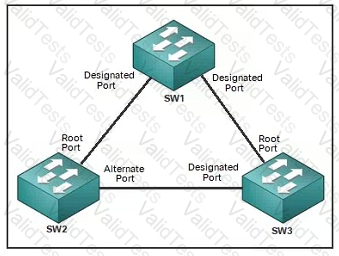
Refer to the exhibit. The connection between SW2 and SW3 is fiber and occasionally experiences unidirectional link failure. An architect must optimize the network to reduce the change of layer2 forwarding loops when the link fails. Which solution should the architect include?

Options:

A.

Utilize 8PDU filter on SW3.

B.

Utilize loop guard on SW2

C.

Utilize BPDU guard on SW1

D.

Utilize root guard on SW1.

Expert Solution
Questions # 93:

Which design consideration should be observed when EIGRP is configured on Data Center switches?
Options:

A.

Perform manual summarization on all Layer 3 interfaces to minimize the size of the routing table.

B.

Prevent unnecessary EIGRP neighborships from forming across switch virtual interfaces.

C.

Lower EIGRP hello and hold timers to their minimum settings to ensure rapid route reconvergence.

D.

Configure multiple EIGRP autonomous systems to segment Data Center services and applications.

Expert Solution
Questions # 94:

Question # 94

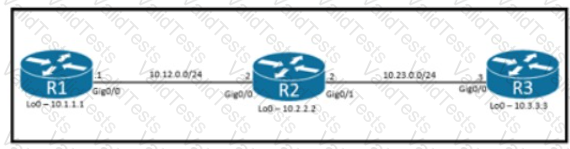
Refer to the exhibit A customer requires maximum uptime for the data plane between R1 and R3 running OSPF Which solution must the design include for high availability if the routing process on R2 requires maintenance?

Options:

A.

BFD on all routers

B.

nonstop forwarding on R1 and R3

C.

nonstop forwarding on R3 only

D.

graceful restart on all routers

Expert Solution
Questions # 95:

What is the purpose of a border node in a Cisco SD-Access fabric?

Options:

A.

connect devices to a network

B.

perform traffic encapsulation and de-encapsulation

C.

perform network virtualization

D.

expand a network

Expert Solution
Questions # 96:

A company must automate a set of complex changes aligned with DR testing in the network. These changes are specific, and the DR playbook will be adjusted in the future. The playbook has diverse routing and switching assets in scope as well as multiple vendor and hardware platforms. A developer will create a thin, web front-end microservice and integrate with an Open daylight controller to push changes to the network. Which YANG model should be used?

Options:

A.

Use a single native vendor YANG model to minimize development time

B.

Use an open YANG model to allow the reuse of code and standardize the implementation across platforms

C.

Use multiple native vendor YANG models to provide code consistency.

D.

Develop an individualized YANG model to minimize development resources and time to market.

Expert Solution
Questions # 97:

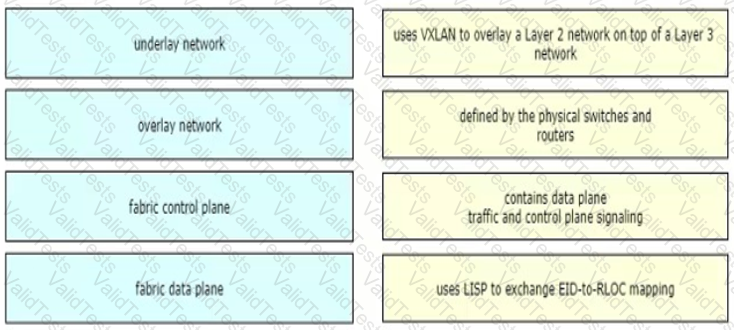
Drag and drop the components in a Cisco SD-Access architecture from the left onto their descriptions on the right.
Question # 97

Options:

Expert Solution
Questions # 98:

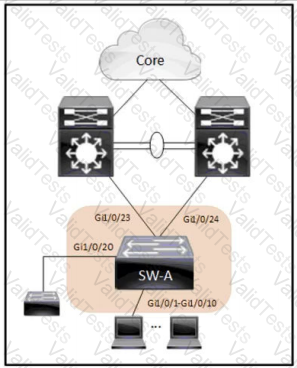
Question # 98

Refer to the exhibit. An architect reviews the low-level design of a company's enterprise network and advises optimizing the STP convergence time. Which functionality must be to Gi1/0/1-10 to follow the architect's recommendation?

Options:

A.

PortFast

B.

root guard

C.

UplinkFast

D.

BPDU guard

Expert Solution
Questions # 99:

A network engineer must segregate three interconnected campus networks using IS-IS routing. A two-layer hierarchy must be used to support large routing domains and to avoid more specific routes from each campus network being advertised to other campus network routers automatically. Which two actions does the engineer take to accomplish this segregation? (Choose two.)

Options:

A.

Designate two IS-IS routers as BDR routers at the edge of each campus, and configure one BDR for all Level 1 routers and one BDR for all Level 2 routers.

B.

Designate two IS-IS routers from each campus to act as Level 1/Level 2 backbone routers at the edge of each campus network.

C.

Assign the same IS-IS NET value for each campus, and configure internal campus routers with Level 1/ Level 2 routing.

D.

Utilize different MTU values for each campus network segment. Level 2 backbone routers must utilize a larger MTU size of 9216.

E.

Assign a unique IS-IS NET value for each campus, and configure internal campus routers with Level 1 routing.

Expert Solution
Questions # 100:

A customer is discussing QoS requirements with a network consultant. The customer has specified that end-to-end path verification is a requirement. Which QoS solution meets this requirement?

Options:

A.

IntServ model with RSVP to support the traffic flows

B.

DiffServ model with PHB to support the traffic flows

C.

marking traffic at the access layer with DSCP to support the traffic flows

D.

marking traffic at the access layer with CoS to support the traffic flows

Expert Solution
Viewing page 10 out of 12 pages
Viewing questions 91-100 out of questions