Summer Certification Special Limited Time 70% Discount Offer - Ends in 0d 00h 00m 00s - Coupon code: validbest

Pass the Cisco CCNP Enterprise 300-420 Questions and answers with ValidTests

Exam 300-420 All Questions
Exam 300-420 Premium Access

View all detail and faqs for the 300-420 exam

Viewing page 11 out of 12 pages
Viewing questions 101-110 out of questions
Questions # 101:

An engineer is designing a campus network with Cisco Catalyst 95CO switches in the aggression layer. The design requires running nonblocking Layer 2 MEC from the aggregation layer to the access layer. The Catalyst switches are located on different campus floors for availability reasons, and each access switch veil contam a single VLAN. Which technology must the engineer choose for the aggregation switches in the design?

Options:

A.

VPC

B.

VSS

C.

StackWise Virtual

D.

StackWise-180

Expert Solution
Questions # 102:

Which node performs the LISP Map-Server and Map-Resolver functions in the Cisco SD-Access network architecture?
Options:

A.

control plane node

B.

fabric edge node

C.

border node

D.

intermediate node

Questions # 103:

Question # 103

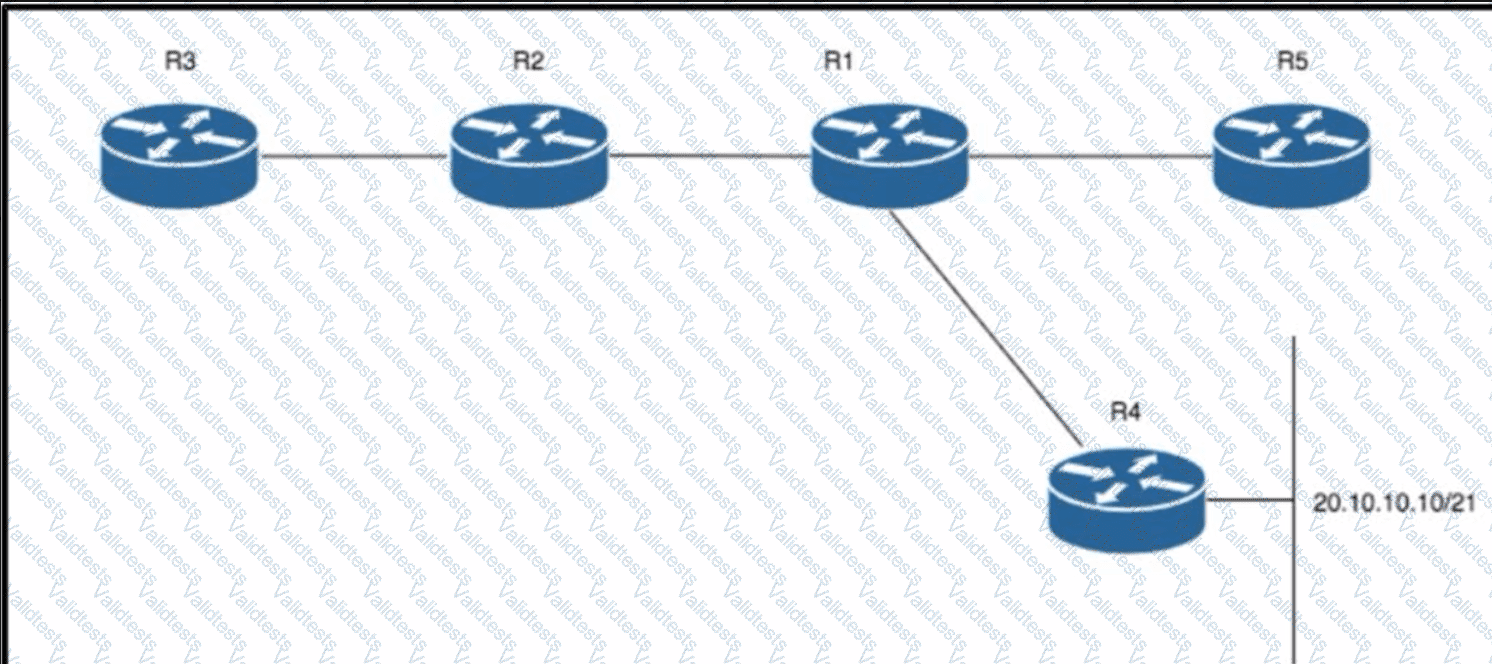
Refer to the exhibit. A network architect is preparing a network design based on EIGRP. Routers are connected using a Cat6a cable type and the inter-router connection speed is limited to 10 Mbps due to distance. During the pilot phase, a DUAL-3-SIA error message is visible. Which action must the engineer take to create a stable design?
Options:

A.

Enable poison reverse on R4.

B.

Create a summary route on R2.

C.

Disable split horizon on R1.

D.

Configure STUB area on R4.

Questions # 104:

Question # 104

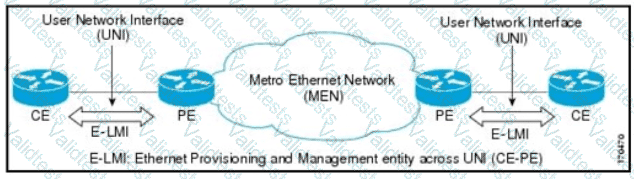
Refer to the exhibit. Which process does the Ethernet LMI protocol follow that is defined by the MEF 16 Technical Specification?

Options:

A.

communicates ENI and EVC attributes to the CE

B.

notifies the CE of the availability state of a configured EVC

C.

broadcasts multicast network routes from the CE to the PE

D.

broadcasts to all subnets from the CE when an EVC is added

Questions # 105:

A customer ' s current Layer 2 infrastructure is running Spanning Tree 802.1d, and all configuration changes are manually implemented on each switch. An architect must redesign the Layer 2 domain to achieve these goals:

    reduce the impact of topology changes

    reduce the time spent on network administration

    reduce manual configuration errors

Which two solutions should the architect include in the new design? (Choose two.)
Options:

A.

Implement Rapid PVST+ instead of STP.

B.

Implement MST instead of STP.

C.

Use VTP to propagate VLAN information and to prune unused VLANs.

D.

Configure broadcast and multicast storm control on all switches.

E.

Configure dynamic trunking protocol to propagate VLAN information.

Questions # 106:

Question # 106

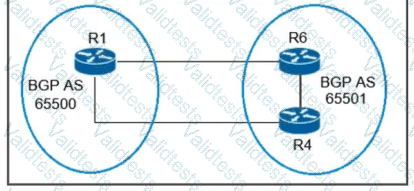
Refer to the exhibit. An architect must design a solution to connect the two ASs. To optimize bandwidth, the design will implement load sharing between router R6 and router R4. Which solution should the design include?

Options:

A.

Use update-source to specify the Loopback interface.

B.

Use next-hop-serf attributes only for routes that are learned from eBGP peers.

C.

Configure the eBGP TTL to support eBGP multihop.

D.

Use maximum-paths to install multiple paths in the routing table.

Questions # 107:

Which NETCONF operation creates filtering that is specific to the session notifications?
Options:

A.

< create-subscription >

B.

< commit >

C.

< notification >

D.

< logging >

Questions # 108:

Question # 108

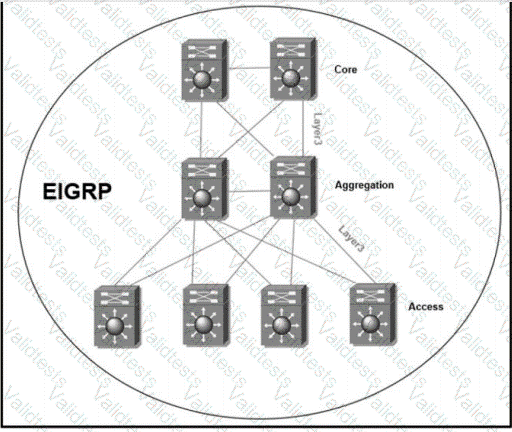
Refer to the exhibit. The full EIGRP routing table is advertised throughout the network. Currently, users experience data loss when any one link in the network fails. An architect optimizes the network to reduce the impact when a link fails. Which solution should the architect include in the design?

Options:

A.

Run BFD on the inter links between EIGRP neighbors.

B.

Summarize the access layer networks from each access layer switch toward the aggregation layer.

C.

Reduce the default EIGRP hello interval and hold time.

D.

Summarize the access layer networks from the aggregation layer toward the core layer.

Questions # 109:

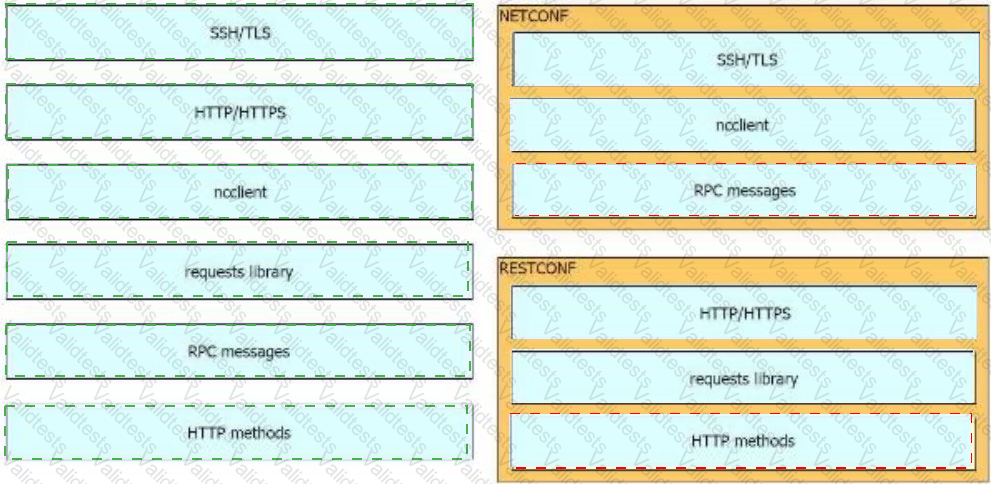
Drag and drop the elements from the left onto the protocols where they are used on the right.
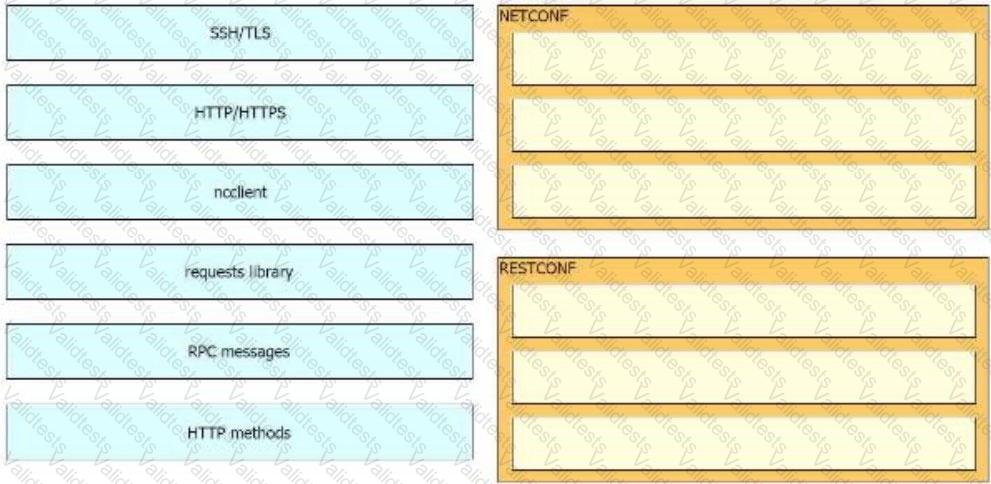
Question # 109

Options:

Questions # 110:

Which PIM mode uses a shared tree only?

Options:

A.

bidirectional

B.

sparse

C.

dense

D.

source-specific

Viewing page 11 out of 12 pages
Viewing questions 101-110 out of questions