Pre-Summer Special Limited Time 70% Discount Offer - Ends in 0d 00h 00m 00s - Coupon code: validbest

Pass the PMI Agile PMI-ACP Questions and answers with ValidTests

Exam PMI-ACP All Questions
Exam PMI-ACP Premium Access

View all detail and faqs for the PMI-ACP exam

Viewing page 8 out of 15 pages
Viewing questions 71-80 out of questions
Questions # 71:

An agile team has been given a complex project with a basic set of requirements which need further elaboration and review. How should the team iteratively build out the backlog of requirements with the stakeholders?

Options:

A.

Conduct a requirements gathering workshop.

B.

Deliver the basic requirements iteratively.

C.

Have the product owner fill out the requirements backlog.

D.

Have the stakeholders fill out the backlog before starting the project.

Expert Solution
Questions # 72:

A project team is working with an enterprise agile center of excellence (CoE) to transition to a Scaled Agile Framework (SAFe). Many of the team members are not familiar with the new methodology and are worried that it will lead to more work and scrutiny.

What should the agile team lead do to help ensure a smooth transition?

Options:

A.

Set up lunch-and-learn sessions with the team to provide overviews about the new way of working.

B.

Encourage knowledge sharing and transparency among the working team.

C.

Request the enterprise coach to help the team through the process

D.

Discuss with the team what will change and when and establish a process to address concerns.

Expert Solution
Questions # 73:

A project team has been working on a new application. The application is technically challenging, because the team is using new technology unknown to the development team and business requirements are unclear. The product owner has been working closely with the stakeholders to ensure alignment with requirements and other issues. The agile lead is working with the team and product owner on the product backlog.

What is the role of the team?
Options:

A.

Estimate and define the work items.

B.

Assess user story quality and independent, negotiable, valuable, estimable, small, and testable (INVEST) criteria.

C.

Add features to the product backlog.

D.

Determine if the demand is or is not feasible.

Expert Solution
Questions # 74:

Question # 74

Case Study

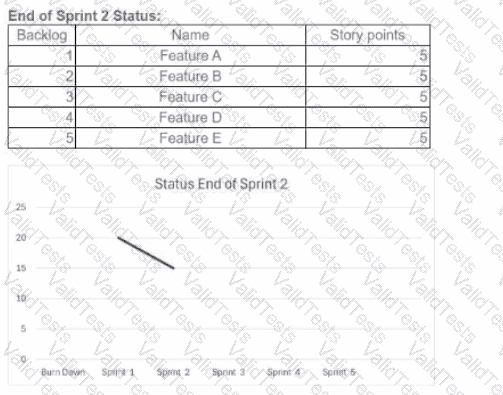
An agile project lead for a company is leading a sales team who has committed to delivering new product functionality to the customer at the end of five sprints. The agile project lead performed initial planning with the team and with the team's support has committed to the scope and deadline.

Check in with the project in three stages to answer the associated questions.

How do two additional features and more story points added by the product owner impact the team's progress and ability to complete work within the iteration, considering the burndown rate of the team has not changed? (Refer to the Case Study and End of Sprint 3 Exhibit)

Options:

A.

The scope of the items in the backlog has been increased to reflect an increase in velocity.

B.

The backlog has been increased and the velocity of the project may no longer be on track.

C.

The team has committed to additional work added to the backlog and will increase velocity.

D.

The team did not complete the backlog items at the same velocity due to external issues

Expert Solution
Questions # 75:

New stakeholders are joining a project team where the agile coach will educate them about their roles and responsibilities.

How should the stakeholders ensure their objectives are met by product delivery?

Options:

A.

Provide feedback for completed user stories.

B.

Define how the features will be implemented.

C.

Tell the team which features to include in the backlog.

D.

Write acceptance criteria for the user stories.

Expert Solution
Questions # 76:

What should the agile team lead do?

Options:

A.

Create a central repository for information, and provide access to Team B

B.

Use an information board that will be visible to all passing through the workspace

C.

Email all stakeholders with status updates

D.

Provide Team B with the information on an "as needed" basis

Expert Solution
Questions # 77:

During sprints, the development team members are frequently invited to various meetings to provide technical opinions, consuming the team's working time and causing compliance issues. Which action should the scrum master take to address this situation?

Options:

A.

Request additional resources to prevent compliance issues while still fostering a collaborative workplace.

B.

Escalate the concern to the product owner and request that they prioritize the development work.

C.

Designate a single team member to attend the meetings and establish a capacity buffer for each sprint.

D.

Reject all external meetings for the development team so they can fully focus on their sprint tasks.

Expert Solution
Questions # 78:

A project team identifies a number of technical challenges with features in the next sprint.

What should they do?

Options:

A.

Request direction from the technical manager

B.

Encourage the Product Owner to reallocate the features to another sprint

C.

Determine who is best qualified to address the challenges

D.

Ask the Product Owner to assign the tasks to the most appropriately skilled resources

Expert Solution
Questions # 79:

During backlog refinement, a team routinely creates tests to demonstrate to the customer that each acceptance criterion has been met. Most acceptance tests results are observable or demonstrable, but testing for one requirement is providing a challenge to the team. The requirement states that the home button should be recognizable and the team is unsure how to test this.

What should the team lead do?

Options:

A.

Determine if the home button is present and if it is shaped like a house, it is recognizable.

B.

Record the product owner's opinion on how they will know if the button is recognizable.

C.

Skip creating a specific test for Ibis particular requirement because it is too abstract

D.

Consult the design team as subject matter experts (SMEs) for criteria on what makes a button recognizable.

Expert Solution
Questions # 80:

During agile training, an aspiring scrum master with experience in predictive projects asks about the differences between the Kanban approach and the agile approach.

How should the agile trainer respond?

Options:

A.

The Kanban approach relies on storyboards.

B.

The Kanban approach focuses on adaptive, simultaneous workflows.

C.

There are no work-in-process limits in the Kanban approach.

D.

Kanban teams employ a pull system.

Expert Solution
Viewing page 8 out of 15 pages
Viewing questions 71-80 out of questions